I love the crafting side of the tabletop hobby, but I struggle to know where to land when it comes to terrain. What’s best for me and my gaming needs?
Sculpted plastic terrain always looks fantastic (especially Warhammer terrain) but it’s expensive as hell and a lot of work to paint. Paper terrain is cheap and easy to make, but does not lend itself well to the immersive quality of miniature gaming I crave. So let’s do a cost-benefit analysis and see what kinds of compromises I need to make with myself in order to stop hyper-focusing on miniature ruins.
Plastic Terrain
The current gold standard for decorating our tabletop battlefields is sculpted plastic. There are plenty of purveyors to choose from, especially if you have access to a 3d printer, but Games Workshop’s stuff tops the list for me.
And that’s the obvious pro: it looks great, even with minimal effort on painting. Basecoat, dry brush, pick out details if you’re feeling sexy, and you’re ready to go. It’s scaled correctly for most games, even if it’s designed for Warhammer. And it’s often generic enough to work for any scifi or fantasy setting.
But it’s expensive. This set, which includes like 5 pieces of scatter terrain and board, costs $100. And if you want it to be fully painted you’re going to have to set aside some time to make it look really cool.
Print and Paste
Paper terrain, and the broader category of “Poorhammer” terrain made from household goods, is a rather big umbrella. So, when I talk about paper terrain here I am specifically thinking about textures and shapes one can print at home, paste onto some card or foam, and then glue together.
Scratch built stuff, as made by favorites like Selrahc and Alrethian, is enjoyable to make and looks great, but it’s even more labor intensive and I don’t feel like making that these days. So let’s stick to print and paste like Crooked Staff.
First of all, it’s cheap. Crooked Staff is generous and keeps his stuff as “pay what you want,” but even big sets of PDFs that will make several boards of unique terrain won’t set you back more than $10. There’s the added cost of paper and ink, but if you have a decent home printer or access to one, I say the gross expense is next to nothing. Throw in glue and stash some cardboard from your last few Amazon purchases and you can make a whole set for less than dinner for one.
Once you have your pieces prepared, there is plenty of necessary elbow grease but it’s not the same as scratch building a grimdark cathedral. Crafting print and paste terrain is somewhere between plastic and scratch built.
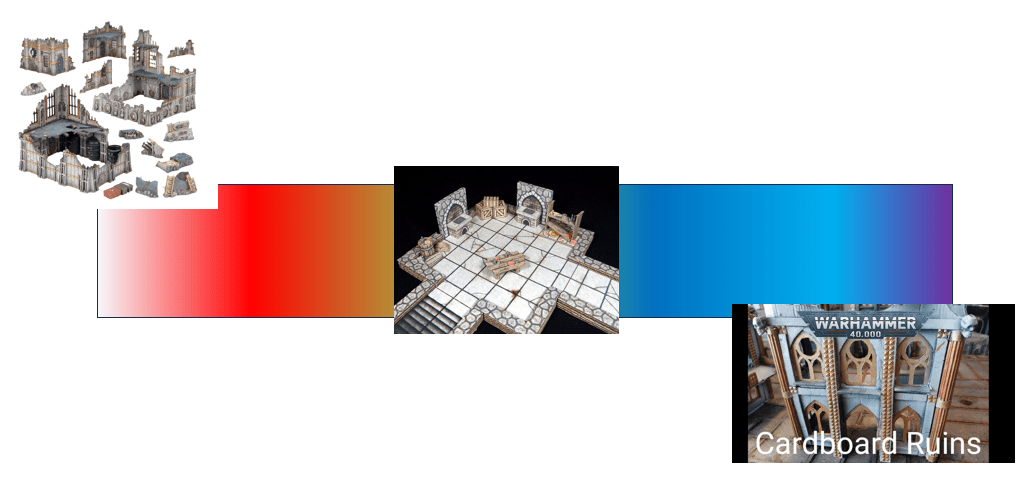
And it can look great. There’s some finesse involved if you don’t want the cardboard and glue showing, but it’s not brain surgery.
 Derek A. Kamal